In Search of the Western Sector - Eden Shopping Centre reviewed
Returning to Newlands was a peculiar experience. I always thought it would be – maybe that’s why I delayed it so long. I attempted to adopt an air of professional detachment which was only partially successful as the project was always a personal journey – as Cathy had printed on the large scale Significant Sites map ‘This is no project – this is my life’.
Eden they have somehow branded this red brick consumerist behemoth, a moloch that will devour our children. A retail concentration camp, shoppers with bar codes burnt into their retinas, the whole scene directed by George A. Romero or John Carpenter – the no-comedy, spoof-free remake.
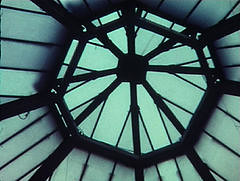
The development process that we documented in our project was one of ultra-artful deception from start to finish – a slick PR-savvy campaign by arch corporate colonists, like the alien invaders in the 80’s sci-fi earth invasion ‘V’ who adopt the guise of friendly attractive humans in order to seduce the human race and offer us amazing visions of the future they will bring us – then once we have given ourselves over to them, lowered our defences they remove their masks revealing their reptilian form and their true intention to farm us for food to feed their insatiable appetite. David Icke would probably close the circle and claim that the head honchos at Multiplex and the quisling Council Leaders who sold out the town are in fact lizard-like shape-shifters, a genetic throwback to a master race who aim to enslave us poor innocent homo-sapiens. I don’t agree with Icke about the lizard thing for the record. I met many of the people responsible for the ‘Horror of Newlands’ and they just looked like perfectly pleasant corporate suits, in much the same way that British colonial viceroys were often urbane, cultured souls. This didn’t prevent the brutality of imperialism – merely meant that it was administered by men who could relate it to the relevant precedent in the classical world. The mark of the colonist was to change the names of local landmarks, towns and villages. And so the Octagon has gone, that dark noxious place full of wonder – a piss-reeking reminder that shopping malls are places to be avoided at all costs. There was no deception with the old Octagon – it spelt it out for you ‘Shopping is Shit’. Where the Octagon still stands now the name reads ‘House of Fraser Eden’. The Octagon is erased from the collective memory – now there is only Eden. Shopping as Soma.
(a recreation of the tour of the site that I did with Cathy in 2004)
And so the Eden Shopping Centre was rationalised in terms of jobs and economic benefits. The havoc it would wreck on the psyche of the town, the scar it would gouge into its flesh was a concept they were unable to engage with. I presented this idea to both the architect of the scheme and the fella at Mulitplex – they simply didn’t have a vocabulary for the experiential qualities of space and place. That a building, especially a large lump of buildings could effect the way you feel, could influence your psychology. They had sophisticated models showing how to drive footfall through the mall, of how to enhance the shopping experience to maximise the consumer spend. But when confronted with the idea that a person might have an emotional response to such a place they were at a loss.
The evidence is there now – the gormless zombies listlessly perambulating from one chain-store to the next. The minimum wage jobs barely paying enough to cover the price of a double-caramel frappucino at BigBucks. The traffic on traction gliding from home to parking-space located conveniently close to the anchor store. The bus delivering you to your retail heaven. This other Eden that looks a lot like Hell to me.
This is a video that we shot back in 2004 recording the experience of the Lunchtime Derive. The algorithm that you see in the video (and the idea of algorithmic psychogeography) was developed by Social Fiction.
The aim of the LunchTime Dérive was to study how, by following a simple instruction, a group of workers could re-experience the town during their Lunch Break. The daily hunt for a prawn sandwich or Chicken Tikka Marsala Ready Meal will be replaced with a drift motivated by following a basic algorithm provided Dutch psychogeographers Social Fiction.
In an email to Cathy I sketch out the theoretical background to the exercise and how we might go about organizing it: According to geographer David Pinder (1996) part of the purpose of the dérive was to allow "participants to drift from their usual activities and to become more aware of their surroundings while simultaneously seeking out ways of changing them." Our intervention is in part in reference to Chombart de Lauwe's study of the movement's made in a year by a Paris student. Guy Debord referred to the data produced by this study as 'a modern poetry capable of provoking sharp emotional reactions.' By asking the office workers to map their usual lunchtime routines we may find that this precious hour of free time is also similarly limited. Debord describes the dérive as a period when one or more persons "drop their relations, their work and leisure activities, and all their other usual motives for movement and action, and let themselves be drawn by the attractions of the terrain and the encounters they find there." We will be asking people to drop their usual lunch-time routine of the trip to M&S for a sarnie or surfing the net a their desk and to follow an algorithm wherever it may take them and experience the town as they find it. We will employ an algorithm to jolt people from their routines and drive the drift most likely taking them into areas they wouldn't normally consider going to at lunch-time. Debord suggests that the dérivers may discover new 'psychogeographical attractions' to which they may be drawn back, in this way our intervention may have deeply subversive consequences in changing the lunch-time habits of a group of office workers, the hunt for grub between 12 and 2 being one of the town's primary motors. By mapping this dynamic then by interfering with it we can start to truly understand and interact with the 'psychogeographical articulations' of the town.
Process: 1. Organize an initial meeting with the workers 1 week or so before the derive. Ask them to map their usual lunchtime movements. 2. On the day of the derive meet the volunteers outside their workplace. Issue them with: notepad, disposable camera, piece of paper containing the algorithm. 3. Make sure that everybody understands the instructions and send the groups of 2-3 people off in different directions. 4. We will accompany the groups to record the event but not intervene. The groups record their route, observations etc. on the notepads. 5. The derive finishes after 30 minutes and we reassemble for lunch and debrief. 6. We collect in notepads and cameras and process the results creating maps of the routes followed. (we could give them a small amount of money to collect food along the way for the lunch at the end)
Rules for a Dérive 1. One or more persons may dérive 2. The most fruitful numerical arrangement consists of several groups of two or three people. 3. It is preferable for the composition of these groups to change from one dérive to another. 4. Drop your usual motives for movement and action, relations, work and leisure activities. 5. The average duration of a dérive is a day, considered as the time between two periods of sleep. 6. The times of beginning and ending have no necessary relation to the solar day. 7. The last hours of the night are generally unsuitable for dérives. 8. A dérive seldom occurs in its pure form. 9. The spatial field of the dérive may be precisely delimited or vague. 10. The spatial field depends first of all on the point of departure. 11. The maximum area of this spatial field does not extend beyond the entirety of a large city and its suburbs. 12. The minimum area can be limited to a small self-contained ambiance (the extreme case being the static-dérive of an entire day within the Saint-Lazare train station). Extrapolated from Guy Debord’s 1958 Theory of the Dérive
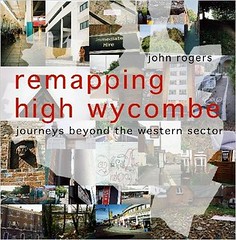
This blog is to track the development of a project by brother and sister team Cathy & John Rogers to remap the area of High Wycombe earmarked for town centre re-development (formerly Project Phoenix). The remapping is to be undertaken in collaboration with community groups in High Wycombe by staging a psychogeograpical event, a walk, a ‘derive‘ within the boundary of the re-development area, the results of which will be used to animate the town centre with a temporary art installation.