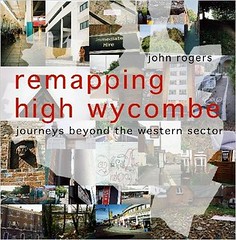
John Rogers was interviewed about Remapping High Wycombe on a Radio 3 documentary about psychogeography, Walking With Attitude, presented by travel writer Ian Marchant. You can listen to the programme here
The show was originally broadcast on 4th December which was the 7th anniversary of the first Nodules of Energy walk. Here is a Super 8 document of the walk
This is a video that we shot back in 2004 recording the experience of the Lunchtime Derive. The algorithm that you see in the video (and the idea of algorithmic psychogeography) was developed by Social Fiction.
The aim of the LunchTime Dérive was to study how, by following a simple instruction, a group of workers could re-experience the town during their Lunch Break. The daily hunt for a prawn sandwich or Chicken Tikka Marsala Ready Meal will be replaced with a drift motivated by following a basic algorithm provided Dutch psychogeographers Social Fiction.
In an email to Cathy I sketch out the theoretical background to the exercise and how we might go about organizing it: According to geographer David Pinder (1996) part of the purpose of the dérive was to allow "participants to drift from their usual activities and to become more aware of their surroundings while simultaneously seeking out ways of changing them." Our intervention is in part in reference to Chombart de Lauwe's study of the movement's made in a year by a Paris student. Guy Debord referred to the data produced by this study as 'a modern poetry capable of provoking sharp emotional reactions.' By asking the office workers to map their usual lunchtime routines we may find that this precious hour of free time is also similarly limited. Debord describes the dérive as a period when one or more persons "drop their relations, their work and leisure activities, and all their other usual motives for movement and action, and let themselves be drawn by the attractions of the terrain and the encounters they find there." We will be asking people to drop their usual lunch-time routine of the trip to M&S for a sarnie or surfing the net a their desk and to follow an algorithm wherever it may take them and experience the town as they find it. We will employ an algorithm to jolt people from their routines and drive the drift most likely taking them into areas they wouldn't normally consider going to at lunch-time. Debord suggests that the dérivers may discover new 'psychogeographical attractions' to which they may be drawn back, in this way our intervention may have deeply subversive consequences in changing the lunch-time habits of a group of office workers, the hunt for grub between 12 and 2 being one of the town's primary motors. By mapping this dynamic then by interfering with it we can start to truly understand and interact with the 'psychogeographical articulations' of the town.
Process: 1. Organize an initial meeting with the workers 1 week or so before the derive. Ask them to map their usual lunchtime movements. 2. On the day of the derive meet the volunteers outside their workplace. Issue them with: notepad, disposable camera, piece of paper containing the algorithm. 3. Make sure that everybody understands the instructions and send the groups of 2-3 people off in different directions. 4. We will accompany the groups to record the event but not intervene. The groups record their route, observations etc. on the notepads. 5. The derive finishes after 30 minutes and we reassemble for lunch and debrief. 6. We collect in notepads and cameras and process the results creating maps of the routes followed. (we could give them a small amount of money to collect food along the way for the lunch at the end)
Rules for a Dérive 1. One or more persons may dérive 2. The most fruitful numerical arrangement consists of several groups of two or three people. 3. It is preferable for the composition of these groups to change from one dérive to another. 4. Drop your usual motives for movement and action, relations, work and leisure activities. 5. The average duration of a dérive is a day, considered as the time between two periods of sleep. 6. The times of beginning and ending have no necessary relation to the solar day. 7. The last hours of the night are generally unsuitable for dérives. 8. A dérive seldom occurs in its pure form. 9. The spatial field of the dérive may be precisely delimited or vague. 10. The spatial field depends first of all on the point of departure. 11. The maximum area of this spatial field does not extend beyond the entirety of a large city and its suburbs. 12. The minimum area can be limited to a small self-contained ambiance (the extreme case being the static-dérive of an entire day within the Saint-Lazare train station). Extrapolated from Guy Debord’s 1958 Theory of the Dérive
Here's a video I made featuring Desborough Hundred Psychogeographical Society member Nick Papadimitriou talking about his practice of 'Deep Topography'
We've developed the work we did with Significant Sites to produce an event in Maidstone for Architecture Week - 'Reframing Maidstone'.
It's an event where archive film clips of the town are transfered to people's mobile phones, they then hunt down the locations of the clips using clues we give them, shoot their own response to the footage and the location, then bring their own clips back the installation at Maidstone Town Hall where they are loaded onto a video map displayed on large plasma screens.
We did it last Saturday and it worked really well, and it will run again tomorrow. If you'd like to participate but can't make it along you can send us a clip of whereever you are and we'll send you a clip of Maidstone in return. (email: reframingmaidstone@googlemail.com)
I've written an outline of the idea of the Kino Derive:
Self-authorship of the landscape: from the Phantom Ride to the Mobile Phone
"The modern avenue served as laboratory for the flâneur, while the contemporary street finds the neo- flâneur manipulating the mediating filters of technology in pursuit of new connections to the landscape." Glenn Bach. Atlas Peripatetic (MFA Project Report).
<1> Film-maker Patrick Keiller has identified that a common feature of the early city films of late 19th and early 20th Century was that they tended to be "one to three minutes long, and consisted of one or very few unedited takes". This format is again becoming popular with the using of online video-sharing, self-broadcasting websites such as YouTube and Google Video. The development of portable devices such as mobile phones presents new opportunities for topographical film-makers as short clips can be shot on the move and sent directly from the location to a website, or another device, where they can be simultaneously viewed and commented upon.
<2> This also has implications for the time-space compression (David Harvey) as people can broadcast to a potentially large audience images of the landscape as they pass through it in real-time and experience moving image bulletins from the past in-situ. Like the early city films these clips or bulletins will necessarily be short and unedited.
<3> Our visions of the landscape can now be filtered through a digital interface. Collectively these visions form a snapshot of the townscape and the personal topographies of the auteurs. The exchange that takes place on a kino dérive between author and instigator/ provocateur transforms the personal into the shared experience of space and place, spanning past and present. A video map is created, logging the journeys undertaken. This then enables us to explore the changes and tensions, highlight historic symmetries and developments.
<4> By viewing archive film images in situ what historical tensions emerge? When standing in Fremlin Walk looking at Sonny Hanson’s film showing Fremlins Brewery in 1938 it’s difficult not to become aware of the economic and cultural transformation that has occurred as we have moved from distinctive local industries to a homogenised shopping mall culture.
<5> Can this simple act of authoring our own representation of our environment somehow give us a link to collective sense of place beyond that defined by urban planning, the privatisation of public space and received notions of localness and belonging? Somehow enable access to what Nick Papadimitriou calls a kind of "regional memory" locked in the landscape. A route to a sense and spirit of place which is inclusive.
<6> With the traditional psychogeographical dérive or drift we seek to strip the city or town bare, to reveal its secrets, its mechanisms and motors. The motivations for engaging in such an activity vary as much as the outcomes. For the Situationists it was a reconnaisance mission for the revolution of everyday life that they sought to bring about. The fact that they moved on from drinking absinthe in Montmatre to being at the heart of the revolt of May ’68 that brought the French government to the brink of collapse suggests some use came from these "journeys outside the timetable."
<7> With a kino dérive we don’t anticipate a revolution in the traditional sense to occur, although it would be nice. It is an experiencing of place through a simultaneous active engagement with moving image and the landscape.
This blog is to track the development of a project by brother and sister team Cathy & John Rogers to remap the area of High Wycombe earmarked for town centre re-development (formerly Project Phoenix). The remapping is to be undertaken in collaboration with community groups in High Wycombe by staging a psychogeograpical event, a walk, a ‘derive‘ within the boundary of the re-development area, the results of which will be used to animate the town centre with a temporary art installation.